We really can’t believe this is our last blog. The adventure of analyzing and interpreting our author has come to an end. So for our final blog, we decided to write a reflection and a summary for our final DH project. Before we get into reflecting on our TimelineJS, let’s see how we started and worked our way through with Thomas Hardy!
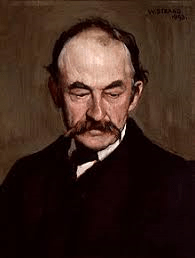
At first, we chose to explain and study monsters written in books. This was our main idea for our class ENGL256B. However, after longs hours of research, we decided to pivot from our original theme and go for Thomas Hardy. We picked Thomas Hardy for several reasons. Thomas Hardy was born on June 2, 1840, in Higher Bockhampton, Dorset, England, to Thomas and Jemima Hardy. Thomas didn’t live a privileged life. His family were extremely poor but his parents did the best to educate him. Even though, they couldn’t afford to enroll Thomas in school, his mother educated him until he was eight years old. He then gained admission at Mr. Last’s Academy for Young Gentlemen. He showed great potential academically but the lack of financial means led to the end of his studies at the age of sixteen. Thomas Hardy wasn’t born into the privileged, well- educated, financially independent class that dominated Victorian Culture. Instead, he was from a rural artisan family which was highly criticized. He adored writing; however, because of his social class he couldn’t truly develop his skills in writing. Following his education, he became a local architect.
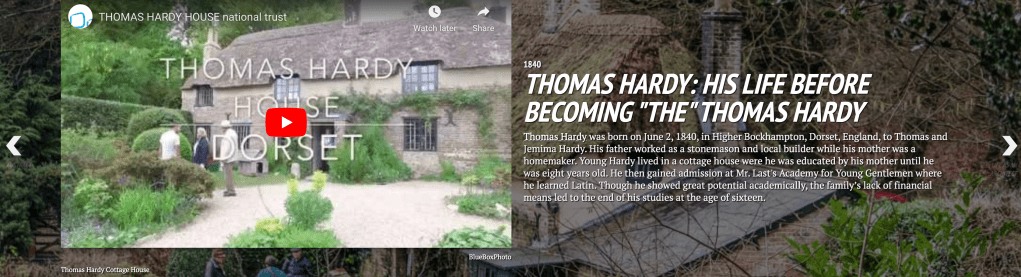
You can notice how Thomas Hardy did not live a privilege life. He had severe financial problems that limited his life opportunities in becoming an author. After a couple of years, he got nominated for the noble prize, was known for his unique novels, and lived in a world where he used to criticize the social status, marriage, and disparities between men and women. These facts triggered our interest into getting to know Thomas Hardy better. These facts were the reason why we wanted to analyze Thomas Hardy more. But before going into the DH tools, we were bewildered and ambivalent about the goals we wanted to achieve throughout the course about Thomas Hardy. It was extremely difficult in picking the most prominent goals in order to convey the best possible analysis about Thomas Hardy. We knew he had a terrible and vile childhood, so that made us ask questions: Does Thomas Hardy’s childhood effect his novels or it has nothing to do with it? Of course, more research was done in order to gain more insights about Thomas Hardy. However, what was more beneficial than our research was the DH tools we learned throughout the course. The first 2 DH tools we learned were: Clic and Voyant. Do you remember them?!
CLIC
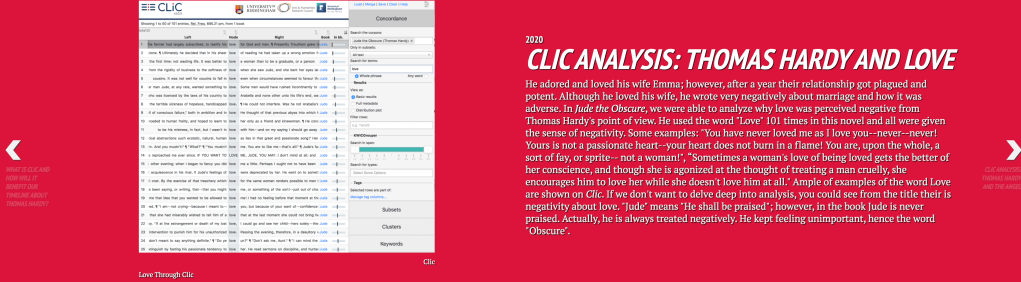
Through our first DH tool, we were able to interpret and find new interesting things about Thomas Hardy. For our corpora, we chose Thomas Hardy and the following books were analyzed respectively: Jude the Obscure and Tess of the D’Urbervilles. We will show a summary of what we found and how it directed us to our new goals for our final DH project. InJude the obscure, we analyzed the word “Love” and we started to gain some insights of what they were talking about. “Love” was used 101 times and this meant that we had to focus on on this particular theme. “Love” as we all interpret it means to be happy and excited. However, in this particular book “love” is darkness and is full of vile stories happening. This shows how Thomas Hardy’s marriage was conveyed in the book through the word “Love”. This gave us more insights, which led us to our new goal!
Goal: How was marriage conveyed in Thomas Hardy’s novels? and how marriage or the Emma (His wife) impacted his writing in novels?
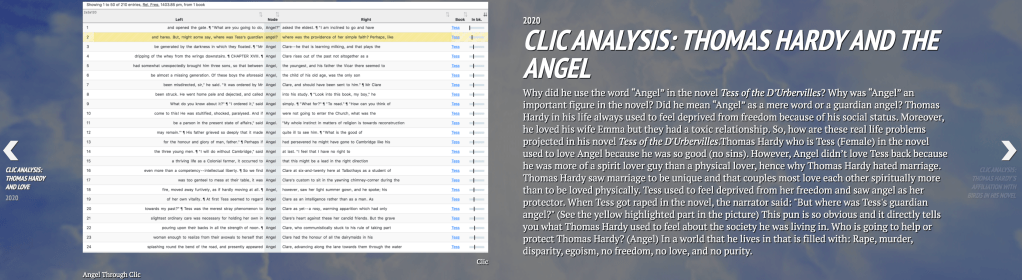
Another Clic analysis was about the word “Angel”. He used the word “Angel” a lot and this triggered our interest into finding out why? We wanted to know if he meant “Angel” as a mere word or a guardian angel? As said before, Thomas Hardy in his life always felt deprived from freedom because of his social status. The same was Tess in his novel (This boosted our goal of finding if his life impacted his writing in his novels). Tess used to feel deprived from her freedom and saw angel as her protector. When Tess got raped in the novel, the narrator said: “But where was Tess’s guardian angel? This pun is so obvious and it directly tells you what Thomas Hardy used to feel about the society he was living in. This gave us another insight on what our new goal would be.
Goal: How did these prominent characters like “Angel” get projected through Thomas Hardy’s novels?
Also in Tess of the D’urbervilles, we found another interesting finding which is also related to our Voyant analysis. Tess in the novel seemed desperate for angel. So, this triggered our inspiration into looking furthermore why Tess is always in need of marriage. With close reading, it seemed as if Tess was desperate, lonely, poor, and without freedom. We started to think why is Tess like that, so we kept on searching for terms (freedom, lonely, desperate, and etc.) After extensive research, we found the term “birds” being used. But that begs the question: Are birds only an object or do they symbolize Tess’s personality? Searching the term birds and close reading we noticed that, birds relate to Tess personality. That was very astonishing because “Birds” symbolize freedom and innocence. The fact that birds were affiliated with humans led us to our third goal!
Goal: Why did Thomas Hardy affiliate creatures with humans?
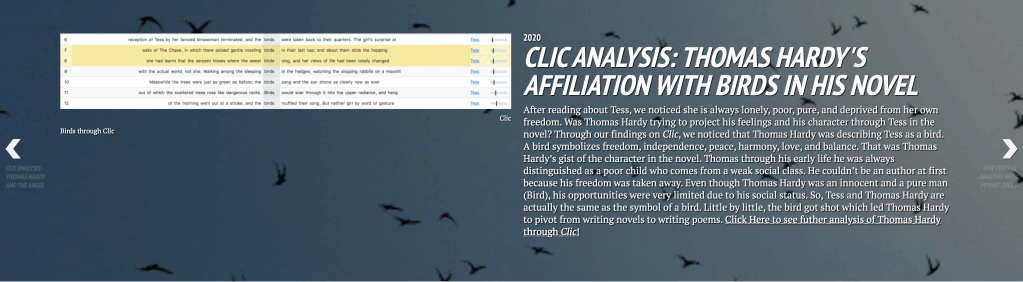
Clic provided these amazing and beneficial findings. These helped us in our analysis about Thomas Hardy and narrowed our goals down. At first, we had this vague idea on what to write about Thomas Hardy but Clic gave us the sufficient amount of data to complete our Final DH project. Also with every tool, you will notice how each DH tool played a role in giving us new insights. Every DH tool gave us another perspective and grew our knowledge in knowing Thomas Hardy better.
Voyant
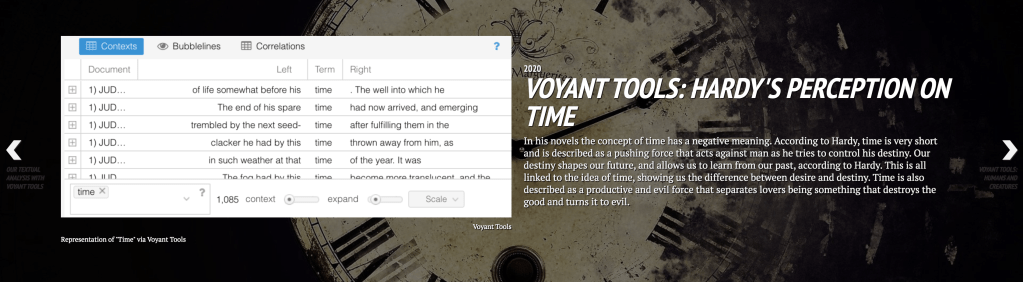
Voyant was another amazing tool that we learned throughout our ENGL256B course. It opened our eyes and showed us other sides of Thomas Hardy. One of our interesting findings that helped us in our final DH project was “time”. The word “time” is remarkably used in Hardy’s novels. Furthermore, using the Contexts tool, Hardy’s use of the word “time” seems to hold a negative connotation in his novels. For example, “little time for correction by experience”, “afraid all this is taking up your time and giving trouble”. “striking of quarters seems to quicken the flight of time”. These quotes indicate the shortness of time which we are constantly battling against. Hardy’s main themes are marriage, death, and social pressure (Philip V. Allingham, 2014). Nevertheless, each theme is portrayed in a negative light, and Thomas Hardy’s perception of time is that it’s a pushing force that acts against man as he tries to control his destiny. Hardy views our destiny as shaping our futures, and learning from our pasts (such as Tess’ struggle to overcome her past), all linking back to the main theme of time. Thus, there is a clear discrepancy between longing and destiny.
Goal: Why did Thomas Hardy have a negative perception of time?
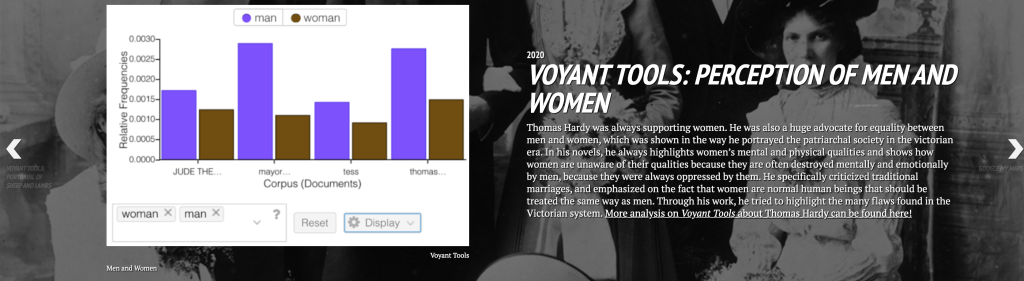
Another perception that Thomas Hardy had was the disparity between men and women. While reading the different sentences, using the tool, when the word man was mentioned, we realized that they were actually put in this context. For example, “I wish we were rich enough to pay a man to do these things,” Tess said” is one of the sentences that actually caught our eyes. In this sentence, the woman is the one doing the housework; in this case, the farm work. Being rich and a man gives you automatic escaping of this kind of work. The level of being a farmer, in that time, on the social ladder was very low. Therefore, this points out the social struggles that females went through back in the Victorian Era. Men were treated as an ideal individual; someone we should look up to and respect. This, therefore, reflects on the display of male superiority at the time.
This created a new goal for us: What was Thomas Hardy perception in his novels about social class and men and women?
Google my Maps
One of the tools we learned was TopoText but after many trials it still did not work. We tried to make it work but it kept on getting stuck on the same page. However, nothing is impossible. We kept researching in order to map our work on Google My Maps. Google my Maps was one of the most fun DH tools to use. We exploited the platform for our study on Thomas Hardy. The platform has so many features that helped us map and better understand Thomas Hardy’s life. Google my maps is all about visualization and almost 65% of the population are visual. This what makes this platform very eye – catching and easily understandable. You can customize your map by adding photos, videos, and notes to each of your layers. It’s highly customizable because so many things can be done on the platform. You can use custom icons, layers, and colors so its easy to read at first glance. But how did Google my Maps help us to complete our final DH project? It helped us in knowing the author better by mapping each part of his life.
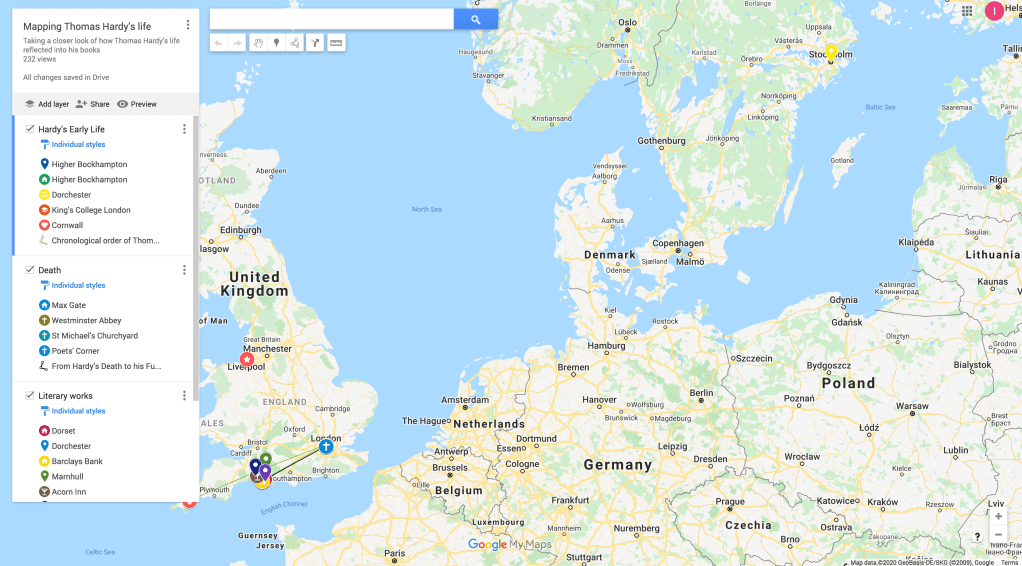
Four layers were mapped on the platform: Hardy’s Early Years, Achievements, Early Career and Literary works, and Death. We were able to map Thomas Hardy’s life and we understood how his childhood effected his writing. However, the most crucial finding we learned from google my maps was the creation of “Wessex”. We found that Hardy created “Wessex”, a semi-real, semi-mythical region that he used in all his novels, however this place is not purely fictional, it is named after Anglo-Saxon kingdom that existed in the southern region of England, Dorset pinpointed in Google My Maps. He chose to create “Wessex” and include it in all of his novels because it’s where he grew up, and felt like this small area was unknown to people so he wanted to give insight into its customs and introduce people to it. He divided Wessex into several regions (south, mid, upper) and assigned each area to a different novel. By doing that, he hoped to create a “series of novels”. For example, in his novel Jude the Obscure (1895), the events of the novel took place in upper-mid Wessex, in Return of the Native (1878), the events take place in South Wessex, and the events of Far from the Madding Crowd (1874), start in Teller Down Gate a region in the southwestern region of England. This was immediately integrated in our TimelineJs project. It was a very important because it shows how Thomas created this relationship between fiction and non-fiction.
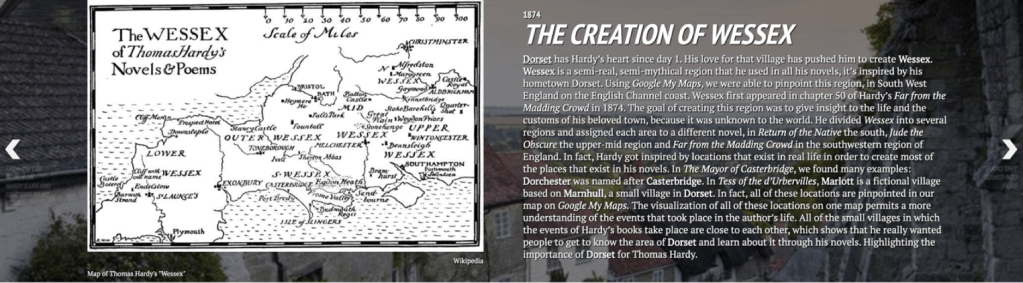
For the final project we integrated all of our findings into TimelineJS. Of course, you noticed how our goals changed massively when new DH tools were introduced. The DH tools made us change our goals throughout the three month of the course. With every DH tool we learned, new findings were achieved and new goals were created. When we first picked Thomas Hardy, the only goal we had was “How Thomas Hardy’s childhood effected his writing in the novels?” After using the DH tools our goals were massively expanded and narrowed down to a specific direction. The tools gave us the right path to follow in order to achieve the most we can about Thomas Hardy.
Main Goals
We were able to achieve our main goals: The disparity between men and women in his novels? Why does Hardy affiliate humans with creatures in his works? How did Thomas Hardy’s personal life affect his style, ideas, and creativity throughout his books? How Thomas Hardy criticized the social class in his novels? These goals were achieved, thanks to TimelineJS and the other DH tools. The DH tools that were introduced to us, such as Google MyMaps, Topotext, Voyant Tools and CLiC, truly allowed us to dig deep into the background of Hardy’s novels, and discover things that were unknown at first glance. We thoroughly analyzed the relevance of word frequencies, the positive or negative connotations associated with them, along with geographical locations, and Hardy’s background that influenced his life and writing. The aforementioned DH tools provided us with the necessary information to create an illustration of Hardy’s life in the form of a timeline using TimelineJS. We were able to embed maps and include pictures, gifs, figures, videos, soundtracks, and screenshots in our timeline in order to create a constructive demonstration of the events that occurred in his life and works. Additionally, the backgrounds had to be chosen at a certain length and height in order to coincide the main multimedia, and the corresponding text. Nevertheless, due to the great features that TimelineJS offers, we were able to showcase all the work we have done for this project in a very organized, concise, and appealing way. The idea of a chronological project truly allows the reader to walk through Hardy’s life like a story, gaining a deeper understanding behind his work and personality.
All in all, these were amazing tools introduced to us. The DH tools gave us intriguing findings to our topic. We were able to see Thomas Hardy from a different perspective and the answers to our main goals. They gave us the right direction towards the right analysis. We learned, as said before in the DH tools, new things about Thomas Hardy’s life. First, we only new Thomas Hardy’s childhood. After looking deeper into the author, with the help of the DH tools, we found new things. The creature’s affiliation with humans, the social class hierarchy, his wife impact on him, and etc. This is all thanks to Dr. Najla Jarkas and the amazing class she has taught. Even though COVID 19 has set us apart, we were able to achieve our goals in the course. ENGL256B is a must course. The course is an eye opener to a whole new different world! We thank you truly from our hearts Dr. Najla, for teaching us this course through these plagued and hard times!
Goodbye Engl256B,

This is the link to our TimelineJs:
If you have any comments, feel free to contact us!
This blog is a collaborative work between my partners Mariame Allaw, Tamara Haidar, Vanessa El Ali, and I.
 Issa's Blog